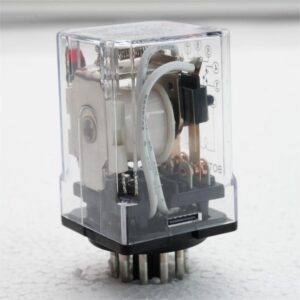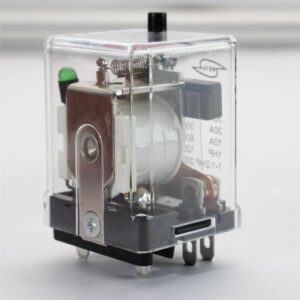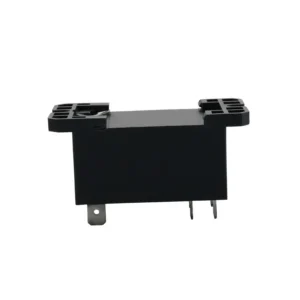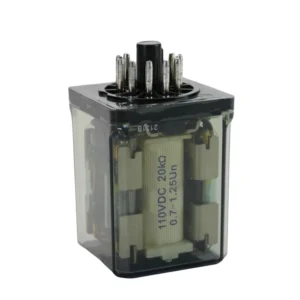
The Omron G7L-X is a compact high-voltage DC power relay designed to switch DC loads up to 1,000VDC, used primarily in energy storage systems, EV charging, and power conditioning. It’s a specialized product built for a job standard AC/DC relays can’t do: safely making and breaking high-voltage direct current. This guide explains what the G7L-X is, where it’s used, and how to approach a custom high-voltage DC relay requirement if you’re evaluating alternatives.
High-voltage DC switching is a specialized discipline. If you have a specific HV-DC switching requirement, the right first step is to define the electrical and safety specification — then assess solutions against it.
What is the Omron G7L-X?
The G7L-X is a 2 Form A (DPST-NO) small power relay engineered for high-voltage DC switching. Unlike a conventional power relay, it’s built to break DC arcs at high voltage — the core challenge in DC switching, because DC current doesn’t cross zero the way AC does, so the arc doesn’t self-extinguish.
Published G7L-X characteristics include:
| Specification | Value |
|---|---|
| Contact form | 2 Form A (DPST-NO) |
| Rating | 20A @ 1,000VDC; 30A @ 600VDC (6,000 ops @ +85°C) |
| Initial contact resistance | ≤10 mΩ (low-resistance G7L-X-SI model) |
| Switching | Bidirectional, with arc cut-off |
| Design focus | Low heat generation at high DC voltage |
Figures per Omron’s published G7L-X data — confirm against the current datasheet for design work.
Why high-voltage DC relays are different
A relay switching 1,000VDC is not a scaled-up version of a 250VAC relay. Three things make HV-DC switching a distinct engineering problem:
- Arc suppression: DC arcs don’t self-extinguish at a zero-crossing (as AC does), so HV-DC relays need dedicated arc cut-off — often magnetic blowout structures — to break the arc quickly and safely.
- Contact material and heat: high DC current through the contacts generates heat; low contact resistance (the G7L-X-SI’s ≤10 mΩ) reduces it and cuts the need for heat sinks.
- Directionality: many HV-DC applications require bidirectional switching (forward and reverse current) from a single device, rather than two relays.
Where the G7L-X is used
The G7L-X and relays like it are core disconnect components in high-voltage DC power systems:
- Energy storage systems (BESS) — battery disconnect and protection
- EV charging and V2H — DC charging circuits, vehicle-to-home systems
- Power conditioning systems (PCS) — inverter and converter switching
- High-voltage DC design generally — solar, DC distribution, and similar
These are safety-critical, high-reliability applications where the switching device’s DC rating and arc performance are central to the design.
Evaluating a high-voltage DC relay for your application
If you’re specifying or sourcing an HV-DC relay, the requirement is defined by:
| Parameter | Why it matters |
|---|---|
| DC voltage rating | The maximum DC the relay must break (e.g. 600VDC, 1,000VDC) |
| Current rating | Continuous and switching current at that voltage |
| Contact form | NO-only, or changeover; single vs bidirectional |
| Arc suppression | Method and rated breaking capacity for DC |
| Contact resistance | Drives heat generation and heat-sink requirements |
| Cycle life | Operations at rated load and temperature |
| Approvals | Safety certifications required for the end system |
Because these applications are safety-critical, a high-voltage DC relay should always be selected and validated against the full specification — not substituted on shape or a single rating.
Custom and build-to-spec relay solutions
MG Relay (BETA / MGRELAY) designs and manufactures custom and build-to-spec relays alongside its standard industrial relay range. For a high-voltage DC switching requirement like the G7L-X application space, the right approach is to start from your specification.
If you’re working on a high-voltage DC switching project — energy storage, EV charging, or power conditioning — send us the requirement (DC voltage, current, contact form, arc-breaking needs, cycle life, and approvals) and our engineering team will assess feasibility and the best path forward.
FAQ
What does the Omron G7L-X do? The G7L-X is a compact high-voltage DC power relay that switches DC loads up to 1,000VDC (20A) or 600VDC (30A), with arc cut-off for safe high-voltage DC breaking. It’s used in energy storage, EV charging, and power conditioning systems.
Why can’t a standard AC power relay switch high-voltage DC? DC current doesn’t cross zero like AC, so a DC arc doesn’t self-extinguish. High-voltage DC relays need dedicated arc-suppression design to break the arc safely — which standard AC/DC relays don’t provide.
Does MG make a high-voltage DC relay? MG designs custom and build-to-spec relays. For a high-voltage DC requirement, share your specification (voltage, current, contact form, arc-breaking and approval needs) and MG’s engineering team will assess feasibility for your application.
Have a high-voltage DC switching requirement for energy storage, EV charging, or power conditioning? Send MG your specification and our team will assess the best build-to-spec solution.